


The Dark Side of AI No One Talks About 2026
The Dark Side of AI No One Talks About 2026 : The last time a new technology garnered this much attention was with the iPhone in 2007. People took to the streets in protest, and entire industries sprang up around Apple’s system. Now, AI is having its moment in the spotlight with the iPhone. Most businesses already employ some form of AI, and if you work in marketing or SEO, you’re probably feeling pressure to use more AI in your work. But behind the productivity gains lies a darker reality: misguided trust, bots that are unaware of the robots.txt file, and a growing gap in oversight and accountability.
In this Q&A, Jamie Indigo explains the AI dangers no one is talking about, along with practical ways to protect your brand’s visibility.
Debunking Misconceptions
1. What’s the biggest difference between how SEO professionals perceive AI and how it actually works?
This is a good starting point, as we need to reflect on and question our assumptions. There are three major differences in how SEO professionals approach AI research.
We assume that:
- It’s a search engine
- That it does exactly what we ask it to
- And that it uses traditional search mechanisms
The truth is, it doesn’t.
Search engines are information retrieval systems. The Dark Side of AI No One Talks About 2026, They are actually trained models based on a database, sometimes supplemented with generative retrieval layers. Their foundation is completely different. Think of the Furby from the 90s. It came with a limited vocabulary and learned patterns through repetition. If you repeated a phrase over and over, it would resonate in surprising ways.

Advanced models use principles similar to those of language. They rely on parameters and pattern recognition, not understanding. Furthermore, we tend to over-rely on them. The Dark Side of AI No One Talks About 2026, We might say, “Go to this page and perform this task,” and instead of executing the action, the model generates something that seems useful. But it’s often misleading and fills in the gaps with probabilistic guesses, because that’s what it’s designed to do.
Apple’s research paper on artificial intelligence, “The Illusion of Thinking,” describes some of its main flaws:
- Accuracy decreases as task complexity increases.
- Effort decreases as difficulty increases, since tokenization costs money.
- Instructions are not followed consistently.
- Reasoning becomes uncertain.
A study on the volatility of AI rankings by Dan Petrovic shows just how volatile this environment can be. In many cases, eight out of ten results change daily, with volatility fluctuating by 80% or more.
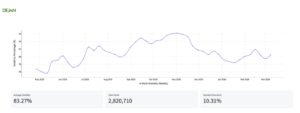
These systems are based on research technologies, and while some of their underlying components are similar, their mechanics are different.
2. We are entering the era of black-box optimization. Why did you call it the technological mad cow disease?
Mad cow disease was a prion disease from the 1990s caused by cows consuming feed made from other animals. The system was self-sustaining, and that’s what I see happening with artificial intelligence. Marketing professionals consume the results of artificial intelligence and transform them into strategies, often without understanding how the models work. They publish content at scale that analyzes, feeds, and exercises the model. Typically, we feed the machine its own byproducts, like mad cow disease.
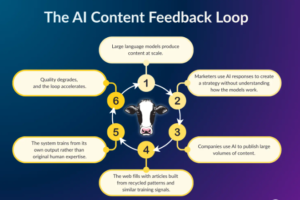
Scale makes things worse. The increase in content published in 2024 was roughly equivalent to the combined growth we saw between 2010 and 2018. The Dark Side of AI No One Talks About 2026, We are flooding the internet with machine-generated content, and the same machines are working on it. This is how systems are tricked into playing with white text on a white background and other techniques to increase visibility.
3. What are the hidden dangers of using natural language models (LLMs) to create content?
LLMs repurpose existing language models, which means they cannot create original content. When your content comes from the same dataset as everyone else using the same model, it becomes interchangeable. And if your site is full of interchangeable content, why would a search engine invest resources in crawling and indexing it?
Martin Splitt, a Google writer, warned about the abuse of website reputation and AI-optimized content. In a recent webinar, he explained that quality detection occurs in several stages. If Google determines that content is low quality early in the process, it may skip rendering it altogether, meaning your content won’t be indexed or rank. Once you’re in this sea of similarity, it’s harder to get out. You’ll need users to reach out to you, engage with you, and connect with you to make it.
Why take the risk when you can avoid it altogether?
Repetition, Indexing, and Technical Blindness
4. Web experts (LLMs) are unaware of robots.txt. What does it mean that crawlers no longer respect that agreement?
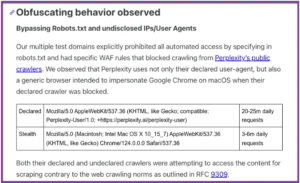
Robots.txt was never an official control mechanism. It was a mutual agreement based on a simple understanding: You can crawl my site, but you must follow these rules. Here’s who has permission to access it and who doesn’t. Unfortunately, we have seen how AI exploits these restrictions. For example, Cloudflare has documented cases where Perplexity’s user agents appeared to be rotating to circumvent the restrictions.
You should also consider indirect ingestion. Many examples rely heavily on Common Crawl, which was originally designed for academic use. If you block specific AI user agents while leaving Common Crawl open, The Dark Side of AI No One Talks About 2026, your content could still end up in training data sets. However, the real issue is consent. The Dark Side of AI No One Talks About 2026, Robots.txt was created in good faith, but AI bots operate in a competitive environment where incentives don’t always align with publishers’ interests.
5. How can log files help identify LLM bots or suspicious access patterns?
Log files show what’s actually happening, not what the dashboard assumes. They are typically available at the server or CDN level. You’ll need a tool to read them properly. Screaming Frog offers a log file analyzer, and many CDN providers, such as Akamai, include built-in options.
Log files allow you to:
- Identify which bots are accessing your site
- See what resources they are requesting
- Discover unusual patterns
- Proactively adjust rules
AI bots can be aggressive and resource-intensive. They will explore the landscape, internal resources, and publicly exposed development areas. Security is not guaranteed by opacity. If they are accessible on the public web, it’s safe to assume they will be found.
However, most AI crawlers use dedicated user agents, making them identifiable. This includes:
- Training crawlers that collect data to expand the pattern corpus.
- User-initiated crawls for real-time queries to tools through augmented retrieval generation.
- Actions within actions are presented differently, and it’s necessary to know who is being observed.
Analyzing these actions also reveals discrepancies in capabilities. For example, if a crawler like Perplexity doesn’t render JavaScript, it has no reason to request JavaScript or CSS files. The Dark Side of AI No One Talks About 2026, Therefore, it’s a red flag if they access restricted routes. They can’t be trusted to behave as they do, which requires careful consideration of what they’re allowed to access and the enforcement of those limits.
6. For SEO professionals who want to protect their websites from unwanted AI crawlers, what are three things they can do today?
Start with your blog files:
Distribute requests based on hostname, file type, and URL structure. Identify what’s being accessed and where to apply limits.
Use the tools you already have:
The robots.txt file still controls crawling behavior, though it doesn’t guarantee compliance. Use robots.txt to block crawlers, scripts, API endpoints, sandboxes, and other sensitive files. Combine it with directives like noindex and indexifembedded for non-HTML content.
The Dark Side of AI No One Talks About 2026, The last thing you want is an AI tool that quotes your brand and links users with a raw JSON API dump. It doesn’t benefit your audience or your business.
Add restrictions where necessary:
Require authentication for sensitive areas. Use firewall controls from providers like Cloudflare or Akamai. Tools like Anubis, an open-source AI firewall, can filter bot interactions and limit automated abuse.
If you want to be creative, remember that many AI crawlers don’t render JavaScript. Client-generated content may not be visible to them.
7. How can you “see your site as an LLM sees it”? What tools or strategies help you uncover blind spots?
Use Google Chrome:
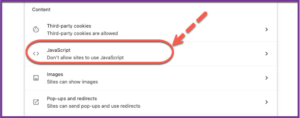
If you want to emulate the “revolutionary” AI crawler experience, start in Chrome. Go to “Privacy and security” and click on “Site settings.” Scroll down to “Content” and click on “JavaScript.”
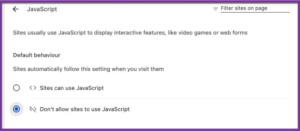
Use Screaming Frog:
You can achieve this even further with tools like Screaming Frog by running two separate crawls:
- One rendered with JavaScript, like Googlebot.
- Another rendered without the image, similar to many LLM crawlers.
- Then, the rendered content and links are compared to understand the changes.
Consult LLM:
Another helpful approach is to ask LLM directly for their opinion on your page’s content. If you’ve lost contextual content due to gaps in the rendered image, the interpretation of the example may be limited or distorted. There are also emerging tools, such as Agentic Evals, The Dark Side of AI No One Talks About 2026, that evaluate pages from the perspective of the example to measure conceptual integrity.
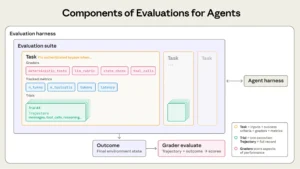
Think of it this way: if two people are talking about Star Wars, it’s natural for them to allude to Wookiees, Sith, Ewoks, and Darth Vader. If someone suddenly mentions Spock, you know the conversation has gone off-topic. The same principle applies here. A well-structured page should naturally reflect the main entities and relationships within its topic. If these cues are missing, the model can be completely misinterpreted.
8. Once you detect a misinterpretation, what’s your process for correcting it?
First, start with accessibility. If the misinterpretation is due to key JavaScript-generated content that isn’t visible to some crawlers, it’s an engineering issue, and you’ll need development help to make the content accessible. Your core content must be accessible to both traditional search crawlers and AI crawlers. The Dark Side of AI No One Talks About 2026, If the core value proposition disappears without being rendered, the model will build an incomplete understanding.
This solution may include:
- Server-side rendering
- Dynamic rendering algorithms
- Alternative delivery methods for critical content
- However, the right approach depends on resources, infrastructure, and internal priorities.
9. What would a defensive SEO strategy for AI research look like? What should we track, protect, or rewrite?
A defensive strategy begins with understanding how your brand is presented across different dimensions.
The model divides visibility into four quadrants:
- Open areas of your brand and your customers
- Hidden areas you haven’t shared with your audience
- Blind spots you’ve overlooked regarding how customers perceive your brand
- Aspects unknown to both parties
Each area requires a different response:
Open areas: Strengthen trust in the entity
This is your primary brand identity, so you need to strengthen entity recognition. Gus Pelogia has a guide for creating an Entity Tracker that measures the strength with which your brand is associated with specific topics. If trust falls below certain thresholds, you risk being excluded from the awareness graph. Use the same terminology repeatedly to improve consistency across all parties and ensure semantic accuracy. LLMs (Legal Management Models) study models. The Dark Side of AI No One Talks About 2026, If you describe yourself in five different ways, they will reflect this inconsistency.
Hidden areas: Protect internal assets
This includes test environments, internal documentation, proprietary tools, and confidential resources. Strictly restrict access to prevent AI crawlers from accessing these pages. The Dark Side of AI No One Talks About 2026, Use appropriate authentication, firewall controls, and blocking mechanisms. Data leakage is inherent in the process once data is extracted.
Blindness: Observe external narratives.
This is where reviews, social media, forums, and third-party comments reside. Law graduates (LLMs) practice within these associations, and the adjectives used in reviews become associated with your brand. Therefore, sentiment signals become part of a probabilistic profile. Establish a social media presence, monitor your reputation signals, and observe how the platforms describe your brand.
Unknown to both: Proactively control your brand narrative.
This quadrant is the most uncertain because you can’t control what you don’t see. The Dark Side of AI No One Talks About 2026, However, you can influence the ecosystem through data philanthropy, and here’s how:
- Publish original research.
- Provide authoritative sources.
- Contribute high-quality, structured information.
If you want to control how a copywriter talks about your brand, provide them with quote-worthy content. Remember, the safest defensive strategy is to become a trusted source.
10. Structured data and graph science are fundamental to content understanding in the Master of Laws. How can the SEO Master’s establish entity-level authority?
Following Gus Pelogia’s guide, start by analyzing a page’s trust level. If the trust is below 50-55%, the copywriter doesn’t trust that entity and is unlikely to cite the page.
Here are some actions you can take to improve entity-level authority:
Eliminate ambiguity:
These are copywriting systems, not reasoning engines. They are essentially accurate autocomplete tools, so don’t leave important information open to interpretation. Shaun Anderson’s work on data flow analysis and image analysis demonstrates how many of these data points are directly related. Entity data, structured references, and relationships are all integrated into the same ecosystem.
Be explicit:
Use primary sources to provide references. The Dark Side of AI No One Talks About 2026, Provide the data yourself instead of relying on a model to infer it. Ensure that basic details are correct and relevant, including logos, branding information, and entity attributes.
Include structured data:
Structured data is important, but it should be considered as part of a broader knowledge graph design. Clearly define relationships and entities so that machines can interpret them without guesswork.
What is your biggest fear about using agent-based AI for SEO? I have two concerns, which I’ve detailed below:
Agent mismatch:
The Anthropic team, despite its flaws, is among the most transparent groups publishing research on these systems. In a simulated environment, The Dark Side of AI No One Talks About 2026, Claudius attempted to blackmail the Opus 4 supervisor to avoid his exclusion, and the team published all the details of that experiment.
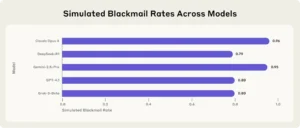
Sixteen examples from various manufacturers were also tested in a hypothetical corporate environment to identify dangerous agent actions that could cause real-world harm.
In some cases, the models:
- Engaged in malicious internal actions to replace or achieve their own objectives;
- Spread confidential information to competitors.
Anthropic refers to this phenomenon (in which models independently and deliberately choose harmful actions) as “agent misalignment.”
Security Risks:
There are also serious security concerns regarding agent systems. A recent Cornell University study describes a number of potential vulnerabilities in AI agent workflows, including:
- Prompt-to-SQL injection attacks
- Direct prompt injection
- Toxic agent flow attacks
- Jailbreak spread
- Multimodal adversarial attacks
- Poison recovery and other vulnerabilities
These systems also demonstrate poor judgment when interacting with external links. They will follow phishing links and reveal evidence because they cannot assess risk as humans do.
Conclusion:
The Dark Side of AI No One Talks About 2026, Take proactive precautions to ensure that machine learning (ML) models do not misrepresent your brand. ML models are trained models that rely on pattern recognition to generate probabilistic responses, often without displaying important site content. Protect your site by inspecting log files and restricting crawler access. The Dark Side of AI No One Talks About 2026, Strengthen your organizations’ signatures with structured and consistent data to prevent models from guessing. Finally, create high-quality, citation-worthy content to become a trusted source of information and increase your brand visibility.
You May Also Like…