

How AI-Generated Content Behave in Google Search
How AI-Generated Content Behave in Google Search: Google indexed most of the pages quickly, but without authority, unique information, or trust signals, the ranking plummeted within months. With artificial intelligence, dozens (or even hundreds) of articles can be generated in a matter of hours and published at scale. But publishing is the easy part. What really matters is what happens after publication. Together with the SE Ranking research team, How AI-Generated Content Behave in Google: we conducted a sixteen-month experiment to investigate the performance of AI-generated content on new, authoritative domains. As you can see, the results were far from successful.
Methodology
The goal was simple: to test the effectiveness of AI-generated content—without human editing, rewriting, or proofreading—in improving search engine rankings. How AI-Generated Content Behave in Google Search: How quickly would it be indexed? Would it appear in relevant searches? And, most importantly, would it generate traffic? We began by editing twenty new domain names with no inbound links, authority, brand recognition, or search history.
Each domain focuses on a different niche, covering topics such as:
- Arts and entertainment
- Business and services
- Community and society
- Computers and technology
- E-commerce and shopping
- Finance and accounting
- Food and drink
- Games and accessories
- Health and medicine
- Industry and engineering
- Leisure and education
- Home and garden
- Office and advanced courses
- Law and government
- Lifestyle and health
- Pets
- Science and education
- Athletics and exercise
- Travel and tourism
- Vehicles and boats
For each niche, we collected 100 informative “how-to” keywords: long words with little content. Each site received 100 AI-generated articles, totaling 2,000 snippets per experiment. After publication, we added the site to Google Search Console and submitted sitemaps. Since then, we’ve left the sites unmodified to observe their performance over time.
Timeline and Key Events
Month 1: Initial Indexing and Visibility
Approximately 71% of the new AI-generated pages were indexed within the first 36 days. How AI-Generated Content Behave in Google Search: They generated over 122,000 impressions and 244 clicks. Even at this early stage, 80% of the sites were ranking for at least 100 keywords each.
Months 2-3: Continued Growth
Cumulative impressions exceeded 526,000, with 782 clicks. How AI-Generated Content Behave in Google: The content continued to perform well without the need for backlinks, promotion, internal linking, or additional SEO techniques.
Months 3-6: Ranking Decline
After approximately three months, only 3% of the pages remained in the top 100. Initial relevance helped the pages get indexed and briefly appear in search results, but without authority, uniqueness, or E-E-A-T signals, rankings plummeted. Google continued to index the pages, but users rarely saw them.
Month 16: Prolonged Stagnation
After more than a year, visibility remained low for most sites. How AI-Generated Content Behave in Google Search: Impressions and clicks were minimal, and no site showed significant recovery. Following Google’s August 2025 anti-spam update, pages in the top 100 increased to 20%, up from 3% six months later.
Month 1: Indexing and Initial Visibility
Just over a month after publication (day 36), the first results came in, and they were better than expected for new sites Of the 2,000 articles, 70.95% were indexed (1,419 pages). For domains lacking authority, this is important to keep in mind, as it’s often difficult to fully index new pages. This demonstrates that Google is still preparing to crawl and index AI-generated content in general. Some pages performed particularly well. How AI-Generated Content Behave in Google; Eleven of the twenty domains managed to have all 100 pages indexed.
- Most belonged to broad, evergreen categories, such as Food & Drink, Home & Garden, Office & Jobs, and Lifestyle & Health.
- More competitive or specialized categories, such as Ecommerce & Shopping, experienced slower indexing, likely due to stricter evaluation.
Along with indexing comes early visibility. During this first month, the pages collectively generated:
- 122,102 impressions
- 244 clicks
Several sites stood out, generating over 10,000 impressions in the first month alone.
- Leisure & Education: 17,425 impressions
- Business & Office: 17,311 impressions
- Travel & Tourism: 13,598 impressions
- Lifestyle & Health: 13,072 impressions
- Law & Government: 11,794 impressions
- Sports & Accessories: 11,083 impressions
- Vehicles & Boats: 10,677 impressions
Regarding keywords, many pages performed surprisingly well during the first month. Eight pages ranked for over a thousand keywords, while another eight ranked between one hundred and one thousand. Even at this early stage, eighty percent of the pages with fully AI-generated content appeared in searches for hundreds or thousands of queries. It’s worth noting that over twenty-eight percent of the ranking URLs were already among the top one hundred. During the first month, many pages gained visibility. Overall, these results demonstrate that AI-generated content can gain traction quickly, even without backlinks, editorial contributions, How AI-Generated Content Behave in Google Search: or additional SEO work. In a short time, the content alone was enough to get indexed and appear in search results.
Months 2-3: Growth Continues
This initial visibility wasn’t fleeting. Over the following weeks, impressions and clicks continued to increase as Google Search discovered and tested the pages. After approximately two and a half months of publication, the cumulative results across all sites had increased:
Impressions: from 122,102 to 526,624
- Clicks: from 244 to 782
Twelve sites ranked for more than 1,000 keywords (compared to 8 in the first month). The remaining 8 sites ranked for between 100 and 1,000 keywords. This is a typical pattern for new sites. When Google finds new content that matches relevant queries, it analyzes it through the results. Pages appear for related queries as Google assesses their relevance. This is what happened in this case. How AI-Generated Content Behave in Google: Even without backlinks, internal links, or SEO improvements, the content gained visibility because it targeted queries with low competition and followed a basic SEO structure. At this stage, it seems like a strong argument in favor of AI-generated content at scale. How AI-Generated Content Behave in Google Search: The sites were new, the content was entirely AI-generated, and impressions continued to grow. But the growth didn’t last.
Months 3-6: Decline in Ranking
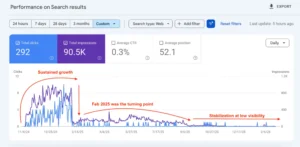
Around February 3, 2025, approximately three months after launch, the experiment reached a critical point.
- Only 3% of pages remained in the top 100, down from 28% in the first month.
In fact, the content remained in the index, but it rarely appeared where users could see it. The relevance of the first page can help it be indexed and appear in search results for a while. Without stronger signals—authority, E-E-A-T (Excellent, Expert, Exploitable, and Unique) information—it’s difficult to maintain this ranking.
Six months ago, Google Search Console showed the following cumulative totals across all sites:
- Impressions: from 526,624 to 706,328
- Clicks: from 782 to 1,062
At first glance, these numbers suggest continuous growth. But that wasn’t the case. Most of the activity occurred at the beginning. In the first two and a half months, the site generated between 70% and 75% of the total impressions and clicks. Over the next three and a half months, growth slowed dramatically, increasing by only between 25% and 30%.
Month 16: Long-Term Outlook
The experiment was run for more than a year to see if the ranking would recover. Overall, it didn’t. Approximately three months after the incident, visibility remained very low for the remainder of the experiment. Some temporary fluctuations were observed. The most notable occurred at the end of August 2025. Starting in August, 50% of the sites (10 out of 20) experienced an increase in impressions over the following two weeks. This coincided with the rollout of Google’s August 2025 anti-spam update, which began on August 26. However, this increase did not translate into a sustained recovery.
Among the sites that experienced a temporary increase:
- Six quickly lost visibility and returned to their previous lows.
- Four maintained slightly better performance, similar to their rankings after the initial rollout.
Following the update, pages in the top 100 increased to 20%, compared to 3% six months later. How AI-Generated Content Behave in Google: This percentage remained below the 28% observed in the first month, but the August 2025 anti-spam update appeared to have improved some rankings.
Overall, 66.9% of pages remained indexed, a slight increase from 61.45% six months prior.
The following websites had the fewest indexed pages:
- Finance domains (9 out of 100)
- Health domains (14 out of 100)
This is likely due to their YMYL (Your Money or Your Life) nature, where Google applies stricter quality and trust standards.
In the sixteenth month, the cumulative results for all sites were:
- Impressions: from 706,328 to 1,092,079
- Clicks: from 1,062 to 1,381
Most of the impressions occurred during the initial growth phase, before rankings declined.
Why didn’t the SEO visibility last long?
The most obvious explanation is that the content didn’t meet Google’s quality standards, and rightly so.
Bimlis’s articles lacked many of the signals Google uses to assess quality and trustworthiness:
- Authority. They had no backlinks or external validation. Without these, new domains struggle to compete with established websites.
- Expertise and trustworthiness. They lacked authors, testimonials, and practical experience—something especially crucial in financial, health, and legal matters.
- Content differentiation. Much of the content was similar to existing material. Without unique ideas, the pages barely stood out.
- Site structure. They lacked internal links, thematic organization, and a clear hierarchy to help Google understand the relationships between pages.
Google can recognize patterns generated by artificial intelligence. Without authority, uniqueness, or supporting signals, initial visibility declines.
Further analysis: How new AI-generated content complements existing pages.
In early March 2026, we conducted a follow-up experiment, adding new AI-generated content to eight monitored sites. As of March 13, not all of the new content had been reported. How AI-Generated Content Behave in Google Search: However, sites with new content are already showing a significant increase in search impressions. Interestingly, this increase comes primarily from older posts, not newly published ones.
For example:
- A business-focused website (from 458 impressions in February 2026 to 7,750 impressions in March 2026): a 17-fold increase.
- A law-focused website (from 19 impressions in February 2026 to 356 impressions in March 2026): a 19-fold increase.
- A science-focused website (from 34 impressions in February 2026 to 633 impressions in March 2026): a 19-fold increase.
This experiment demonstrates that publishing new content, even content generated entirely by artificial intelligence, can increase traffic to older pages that have been stagnant for months. How AI-Generated Content Behave in Google: New content can signal to Google that a site is active and up-to-date, giving it a temporary boost. However, these are preliminary results and do not guarantee long-term increases in ranking or traffic.
Artificial intelligence can accelerate content creation, but it is not a substitute for SEO.
The results of this 16-month experiment do not mean that AI-generated content is useless. How AI-Generated Content Behave in Google; They demonstrate that AI alone is not enough to achieve long-term results. Initial traffic and impressions may seem promising, but without a clear SEO strategy and expert guidance, those increases are likely to fade within a few months.
You May Also Like…